




Overview
FUT removes a thin strip of scalp from the back of the head, dissects it into follicular units under magnification, and leaves one linear scar.
Doctours does not book FUT: as of November 2026, none of its 28 active hair packages across 15 partner clinics lists it.
FUT tends to suit people with a narrow donor zone and a flexible scalp who keep their hair at least about an inch long, and it is a poor fit for anyone set on a buzz cut or with a history of keloid scarring.
Stitches usually come out around day 8 to 10, transplanted hair typically falls out within two to eight weeks, and most people see results between six and nine months.
One 2021 study put the total cost of a US hair transplant near $13,610 across techniques, while Doctours' flat-rate hair packages priced in USD currently run $2,500 to $7,000 if FUE turns out to fit.
An FUT hair transplant removes a thin strip of scalp — roughly 0.5 to 1.5 cm wide — from the back of your head, splits it into individual follicular units under magnification, and places those grafts into thinning areas, leaving one linear scar that your hair has to cover. The International Society of Hair Restoration Surgery (ISHRS) describes it as a method still widely practiced, even as FUE has become the more popular choice.
Let's get the awkward part out of the way: you can't book FUT through Doctours. We checked our own catalog for this article. As of November 2026, none of the 28 active hair packages across our 15 partner clinics lists FUT — where a technique is named, it's FUE, DHI, or a variant of those. You may spot FUT on a partner surgeon's CV, but a line on a CV isn't a package we can book. So nothing here is a pitch for a strip procedure.
If a surgeon brought it up, or you've read that it's either obsolete or secretly better, you probably have one thought on repeat: Is this the old way, or the option nobody's telling me about? Fair question. And honestly? It's neither. FUT is an established surgery with a real upside and a real cost, and you deserve to hear both before you decide anything.
What follows is how the surgery runs, who it tends to suit, the stitches and the scar, the risks, the results timeline, and the price. If you want the two techniques head to head, our FUT vs FUE comparison does that job, and our FUE explainer covers the other method.
What Is FUT, in Plain English?
FUT stands for Follicular Unit Transplantation. Hair grows in natural groups of one to four hairs called follicular units, and those are what get moved. In FUT, the surgeon takes a single strip of hair-bearing skin, 5 to 30 cm long, from the back of the head and closes the gap. A team then cuts that strip into grafts. You'll also see it called strip surgery, FUSS, or linear strip excision. Same operation.
The difference from FUE is where the grafts come from: FUE punches units out one at a time, while FUT gets them all from one strip. FUE is now far more common. In the ISHRS 2025 Practice Census, responding physicians said strip harvesting made up 12.5% of their male procedures and 30% of their female procedures in 2024. Less common isn't the same as outdated, though. The ISHRS FUT guidelines call FUE and FUT "both current standard practices."
As for us: Doctours, a US-based facilitator, coordinates hair transplants at 15 vetted clinics in Turkey, Mexico, Poland, the United States, and South Korea. FUT isn't part of what we book.
How Is FUT Performed, Step by Step?
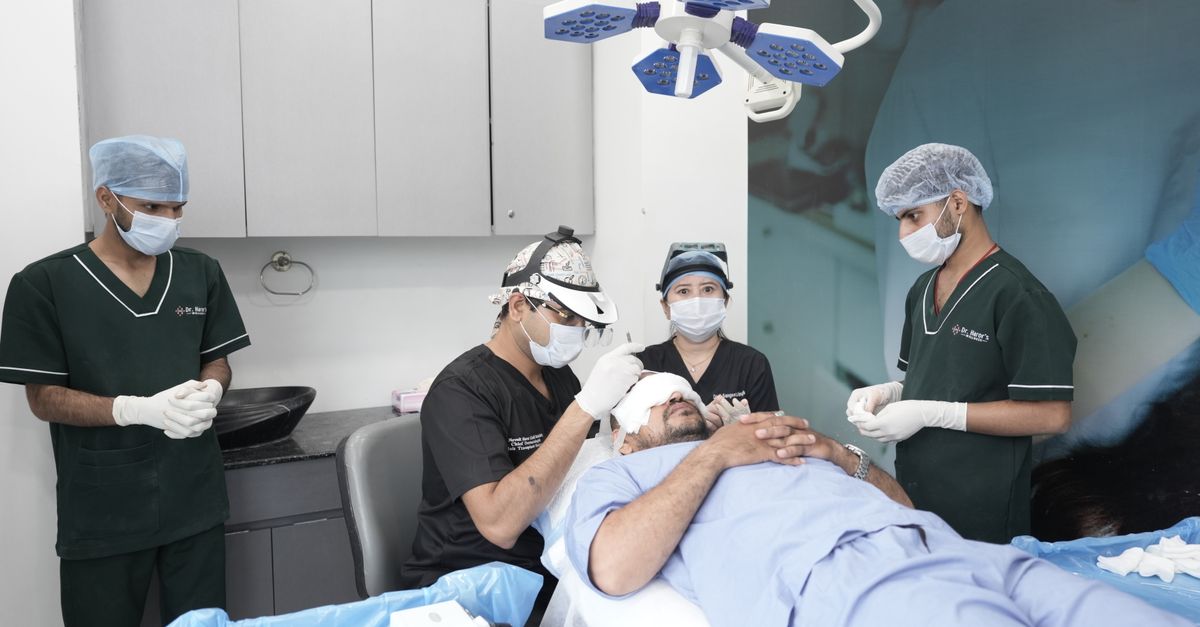
A hair transplant usually takes four to eight hours, and most people stay awake with a numb scalp. Here's the order of an FUT, based on the ISHRS guidelines:
Numbing. Your surgeon injects local anesthetic into the scalp, usually with a sedative to make the injections easier.
Strip excision. The surgeon marks and removes the strip from the densest, most permanent part of the donor zone. ISHRS says the physician doing this needs formal surgical training.
Microscopic dissection. Technicians slice the strip into single-row slivers, then into individual grafts at about 10× magnification, keeping the tissue from drying out.
Recipient sites. The surgeon makes tiny incisions in the thinning area. ISHRS says the physician should personally do this step, because direction and angle shape how natural the result looks.
Placement. The grafts go into those sites using forceps or implanters, usually handled by the team.
Closure. The donor wound is closed with stitches or staples, with as little tension as possible. This often happens while the team is dissecting, so the steps overlap in real life.
Put simply, this is a team surgery, so ask who does each step. Doctours personally visits and credential-checks every partner clinic through our clinic vetting process — but that covers clinics in our network. For an FUT elsewhere, those questions are yours to ask.

Who Does FUT Tend to Suit?
There's no perfect candidate, and only a clinician who has examined your scalp can tell you whether you're a good one. That said, the ISHRS guidelines and its patient guide to FUT describe some patterns. FUT tends to be considered when you:
Wear your hair at least about an inch long and plan to keep it that way
Have a narrow safe donor zone and good scalp elasticity
Have very advanced loss, such as Norwood 6 or 7, where FUE harvesting room can be limited
Don't want large areas of your head shaved
Are thinking about lifetime supply, since ISHRS says most patients can get more grafts over a lifetime from FUT than FUE
And it tends to be ruled out if you worry about a linear scar, prefer or need short hair, have a tight scalp, or have a history of keloid or hypertrophic scarring or poor wound healing. General thinning in the donor area can rule out FUT — or any transplant. The American Academy of Dermatology adds that men in their 20s may be asked to wait and start on medicine first.
Here's the honest part: if several of those first bullets sound like you, an FUE package from us isn't automatically an equal swap. Doctours can't offer you the strip option, and your donor capacity may matter more than convenience. The ISHRS Find a Doctor tool lets you search for member surgeons by location, so you can ask one directly.
What Is FUT Recovery Like, and When Do Stitches Come Out?
The closure is the main difference from FUE recovery. This is the typical shape of it:
When | What's typical |
|---|---|
First week | Some pain or discomfort from the closure, usually manageable with pain medication (ISHRS guidelines) |
Day 2 to 3 | Most people can shower and gently clean the wound |
Day 8 to 10 | Stitches usually come out; Cleveland Clinic says about 10 days. Some surgeons leave certain sutures in for up to 3 weeks |
Through day 10 to 14 | No scratching or towel-drying that could disturb the sutures |
Several weeks | Avoid stretching your neck |
6 months to 2 years | The scar keeps maturing (strip harvest review) |
One thing worth knowing if privacy is on your mind: because the donor area isn't shaved, ISHRS notes it stays hidden from the moment surgery ends, unlike the visible scabs of shaved FUE. That covers the back of your head, not the grafts up front. ISHRS is also clear that aftercare differs by surgeon, so your surgeon's instructions outrank this table. Staples, for what it's worth, are quicker for the surgeon but tend to be less comfortable when you sleep and when they come out.
Doctours' 12 months of US-based aftercare comes with a procedure booked through us, so if you have FUT elsewhere, plan your follow-up with that surgeon's team.
Will the FUT Scar Show?
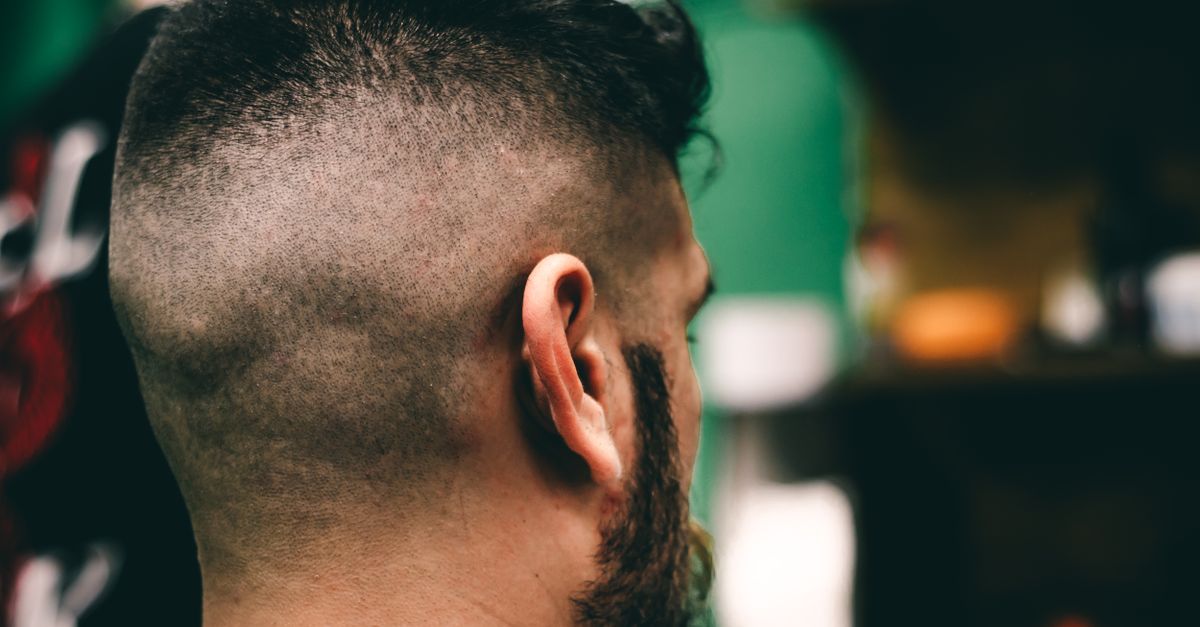
It can. FUT leaves a permanent line across the back of your head, and ISHRS says you'll typically need to keep at least 2 to 3 cm of hair for life to cover it. A buzz cut is where this surgery gets hard to hide.
A trichophytic closure is the main way surgeons try to soften that. They trim a step of about 1 mm from one wound edge, so hairs grow through the scar instead of stopping at it. One review describes the result as usually no more than 2 mm wide. It's not a guarantee: closing under tension can widen a scar, and widened scars are uncommon but hard to correct. FUT scar repair options include re-excision, grafts into the scar, and scalp micropigmentation, and our scarring guide goes deeper.
Doctours packages use FUE-based harvesting, which swaps the one line for many tiny round scars. That's a different trade, not a scar-free one.

What Are the Risks of FUT?
FUT is surgery, and as ISHRS puts it, a transplant can be revised but can't be undone. The risks that come up most in the ISHRS guidance:
Pain. It can be more than with FUE in some cases, usually managed with medication.
Numbness or altered sensation. Rare, above the incision, and it may be temporary.
Shock loss. Native hairs near the surgery can shed. This is typically temporary.
Infection and cysts. A very minor risk, usually minor and self-limiting when it happens.
A wide or visible scar. Uncommon, and more likely with tension or a history of poor healing.
A tighter scalp. Removing a strip can rule out a second strip surgery later.
The ISHRS guidelines themselves note a lack of large randomized studies, so treat any very exact complication percentage you see online with some caution. For procedures booked through us, Doctours adds in-person clinic vetting and US-based aftercare. That supports you. It doesn't remove surgical risk, with any technique.
When Will You See Results After FUT?
Slower than you'd like. The American Academy of Dermatology says transplanted hair falls out between two and eight weeks after surgery, and that by the third month your hair may look thinner than before. Normal, even if it doesn't feel that way. Cleveland Clinic puts regrowth at roughly three months out. Most people see results between six and nine months, and for some it takes 12. That timing is general hair transplant guidance rather than FUT-specific data, and our month-by-month timeline walks through it.
Expectations matter too. AAD says a full head of hair may be unrealistic, while a fuller one can be the goal. Hair loss can also keep going around the grafts, which is why surgeons often bring up hair loss medicine. Whether it makes sense for you is a conversation for your clinician.
How Much Does FUT Cost?
We can't give you a Doctours FUT price, because we don't sell one. Credible FUT-only figures are also hard to find. One paper cites a 2021 study of 90 clinics that put the total cost of a US hair transplant at about $13,610, across techniques. It also notes that FUE costs more than strip harvesting, and ISHRS says FUT may cost less because it takes less of the surgeon's labor. Get an itemized quote from any surgeon you're considering. Insurance rarely covers elective cosmetic surgery.
If FUE turns out to fit, here's what exists. Flat-rate hair packages priced in USD currently run from $2,500 to $7,000, with deposits from $300 to $1,000. A few clinics price in euros, up to €8,690, and one Seoul clinic charges $3 per graft. Our pricing page explains how those totals are built. These are a few that may interest someone who was looking at FUT, not equivalents to it:
Clinic and package | Listed method | Price | Graft cap | Why it might matter to you |
|---|---|---|---|---|
Fizyoestet Hair, Standard (Istanbul) | FUE or DHI | $2,700 | None listed | Lower end of the flat-rate range |
Dr. Hakan Clinic, Standard 5k (Istanbul) | FUE and DHI | $5,000 | 5,000 | Larger stated cap, if your donor area supports it |
Klinika Borejsza, Standard (Poland) | FUE | €5,500 | 3,500 | European option with FUE as the listed method |
Heva Clinic, No Shave FUE (Istanbul) | LHE (no-shave) | $6,000 | 1,500 | No shaving of the donor or transplanted area |
A cap isn't a promise. Your surgeon decides what your donor area can give. Doctours is free for patients because clinics pay us for coordination, and monthly financing up to 36 months runs through partner lenders for patients in the US or Canada, subject to credit approval. You can compare every package in the Doctours partner network.
The Bottom Line
FUT is a real, current option: one strip, one line, and an efficient way to use a limited donor zone. In exchange, you live with a scar and keep some length for good. For the right person, that's a smart trade. For someone set on a buzz cut, it isn't.
Doctours can't book FUT, and we'd rather tell you that than steer you. If strip surgery is where you land, an experienced surgeon from the ISHRS directory is a solid place to start. If FUE looks like the better fit once you've had that conversation, we're here for that.
You've been carrying this question for a while. Now you can walk into any consult knowing what to ask. Whichever way you go, the choice is yours.
Still working out which route fits? Our intake quiz matches you with FUE and DHI clinics in our network that may suit your case, with no obligation.

FAQs
Can I get an FUT hair transplant through Doctours?
No. As of November 2026, none of the 28 active hair packages across Doctours' 15 partner clinics lists FUT; where a technique is named, it is FUE, DHI, or a variant. If you want strip surgery, the ISHRS Find a Doctor tool lets you search for member surgeons by location.
Is FUT outdated?
No. Many surgeons and patients see it that way, but the 2024 ISHRS guidelines describe FUE and FUT as both current standard practices. It is less common: in the ISHRS 2025 Practice Census, responding physicians reported strip harvesting in 12.5% of male and 30% of female procedures in 2024.
Does FUT leave a permanent scar?
Yes. FUT leaves a linear scar across the back of the head, and ISHRS says you typically need to keep at least 2 to 3 cm of hair for life to cover it. A trichophytic closure can help hairs grow through the scar, but it does not guarantee an invisible result.
How long after FUT can I go back to work?
There is no single number, because recovery varies by surgeon and patient. Expect some discomfort in the first week, with stitches usually out around day 8 to 10; the unshaved donor hair generally hides the closure, though not the grafts up front. Ask your surgeon based on your job.
How much does FUT cost in the United States?
Credible FUT-only figures are hard to find. One 2021 study of 90 clinics put the total cost of a US hair transplant at about $13,610 across techniques, and ISHRS says FUT may cost less than FUE. Doctours does not list an FUT price because it does not book the procedure.