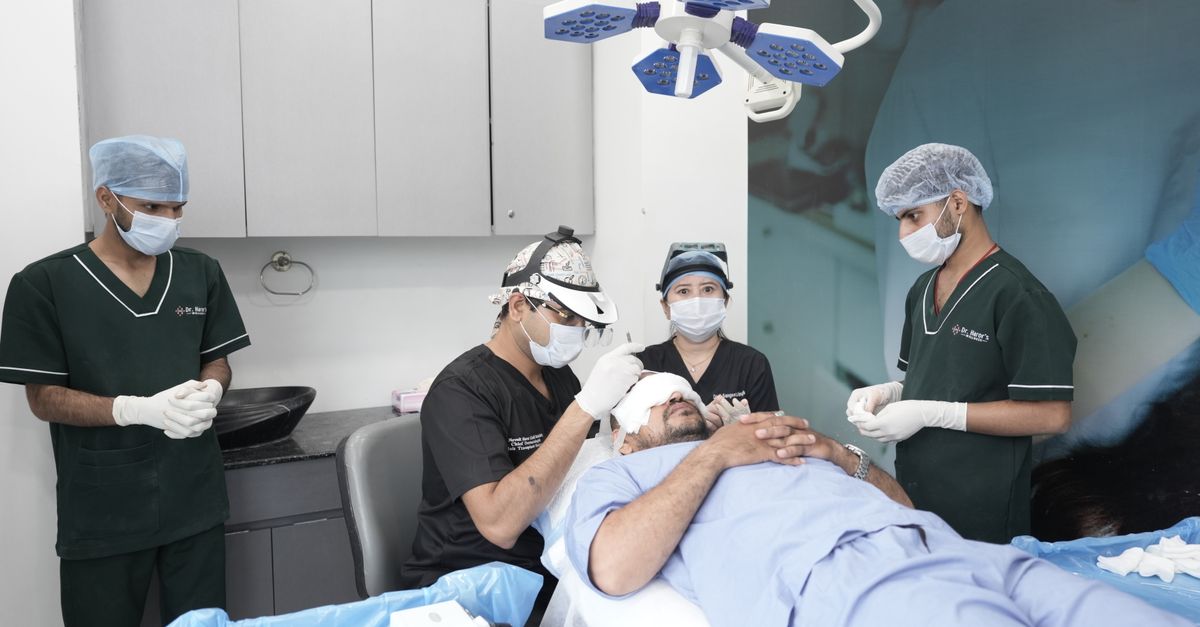




Overview
An FUE hair transplant removes small groups of follicles one at a time from the back of your scalp with a punch 1 mm or smaller and places them into thinning areas, leaving small round scars rather than one linear scar.
FUE is still surgery, and the question that matters most is who does each step: the ISHRS says graft excision belongs with trained, licensed physicians, while actual practice varies by clinic and package, including within the Doctours network.
Your donor hair is finite, so overharvesting is a real risk: no standard limit exists, though many authors recommend taking 10% to 20% of baseline density per session.
Crusts usually clear by about day 10, shedding commonly hits between weeks 2 and 8, regrowth usually begins near month 3, and final growth typically takes about 12 months.
Through Doctours, the FUE packages in this guide run from $2,500 to $6,000 in USD, with deposits from $300 and 12 months of US-based aftercare.
An FUE hair transplant (Follicular Unit Extraction, also called Follicular Unit Excision) is surgery that removes small groups of hair follicles one at a time from the back of your scalp using a punch 1 mm or smaller, then places them into thinning areas, leaving small round scars instead of a linear one, with final growth around 12 months.
Doctours is the US-based medical tourism facilitator that helps you compare, book, and pay for hair transplants at 15 personally vetted clinics in Turkey, Mexico, Poland, the United States, and South Korea. The FUE packages in this guide run from $2,500 to $6,000, and one Seoul clinic charges $3 per graft.
FUE has become the predominant hair transplant technique, overtaking strip surgery because it is minimally invasive, recovers faster, and leaves no linear donor scar, according to a 2026 review of FUE complications. Strip surgery is a separate procedure called FUT, and if you are weighing the two, our FUT vs FUE comparison is the place to start. The names you keep seeing are mostly about the recipient side. Sapphire FUE refers to how the channels are opened, and DHI refers to how grafts go in with an implanter pen. The ISHRS, the hair restoration surgery society, does not recognize either as a separate transplant method.
If you have spent time in clinic pages and forum threads, you have probably absorbed the story that FUE is quick, gentle, and basically scarless. Is it really that simple? Fair question. Here is the honest version: FUE has a low rate of major complications, and it is still real surgery — thousands of small cuts in your scalp. Wanting to understand exactly what happens before you say yes is not overthinking. It is how you choose well.
How Does FUE Actually Work, Step by Step?
The donor area is the hair at the back of your head. Everything in an FUE procedure comes down to moving some of it without damaging the follicles or leaving the back looking thin.
Donor preparation. The team assesses follicle density, hairs per graft, hair thickness, and miniaturization, per the same 2026 review. The donor area is typically shaved for access, and local anesthesia numbs large areas of the scalp. Most people stay awake.
Punch extraction. A small round micro punch scores around each follicular unit, which is then lifted out with forceps or suction.
Graft handling. Grafts wait outside the body until they are placed. The review recommends minimizing that time, keeping grafts hydrated in chilled isotonic solution, and handling them gently, though it says evidence tying specific handling choices to outcomes is still limited.
Recipient sites. Small incisions are made in the thinning area. Their angle and direction shape how natural the result looks.
Placement. Grafts go into those incisions with forceps or an implanter. Sharp implanters make the incision and place the graft in one motion.
A session can take several hours, and the ISHRS notes that sessions can exceed 4 hours. Most people go home the same day. Before you travel, Doctours sends your medical history to its medical team, and the surgeon sets the final graft count and hairline in person on procedure day.
Who Is FUE a Good Fit For — and Who May Not Be?
FUE tends to suit people with healthy hair growth at the back and sides of the head, good overall health and realistic expectations. It often appeals to people who wear their hair short and want to avoid a linear scar, as an ISHRS article on donor planning notes. The same article says people have 6,000 to 8,000 grafts at the back of the head on average, so the supply is real and finite. How surgeons measure your supply is worth reading before you fall in love with a graft number.
It may be a harder fit, or need more medical review, if any of these apply:
Very little donor hair. A surgeon may advise against surgery when there is little hair to move.
Extensive hair loss. For Norwood 6 or 7, the ISHRS article says combining FUT and FUE over time may do more than FUE alone.
Health factors. The 2026 review lists diabetes, hypertension, and smoking as risk factors, along with a tendency toward abnormal scarring.
Loss that is undiagnosed or still moving. Hair loss has many causes, and a transplant moves hair without stopping further loss. Hair loss medicine is a separate conversation to have with a clinician, and scarring hair loss needs its own evaluation.
None of this is a yes or no for your case. Only a licensed clinician can make that call. Doctours asks you to put health conditions on your medical history form so its medical team can review them, and our guide to common disqualifiers goes deeper.

Who Performs the Extraction: Surgeon or Technician?
Let's get the big question out of the way. A lot of people assume the surgeon holds the punch for every graft. That is not always what happens.
The ISHRS position statement is direct: cutting out FUE grafts and creating recipient sites are surgical procedures that must be performed by a properly trained, licensed physician. Where accredited professionals such as nurse practitioners or physician assistants are licensed for this work, the ISHRS accepts it within their license and under a licensed hair surgeon's supervision. Its patient FAQ goes further, saying improper delegation laid the groundwork for a black market in hair surgery, and that if a doctor delegates to an unlicensed technician, you should find out whether that is legal where you are having surgery. It also says ISHRS membership is no guarantee, because its member agreement depends on an honor system. The 2026 review adds that procedures in poorly regulated settings have contributed to preventable complications.
Real-world practice does not always match that standard, including at clinics you can book through us. Across our network, who does what varies by clinic and by package. At some, doctors do the extraction and incisions while licensed nurses place the grafts. At others, the lead doctor designs the hairline and opens the channels while the team extracts and implants. And some packages are technician-led.
That is why the question to ask is not Is there a doctor here? Who does each part is what counts. These are drawn from the ISHRS patient red flags and FAQ:
Who is the physician responsible for my care, and will I meet them before the procedure?
Who will design my hairline, give anesthesia, make the incisions, and do the follicular excisions?
Which parts are handled by technicians or assistants, and what are their credentials?
How many surgeries run at the same time under this doctor?
Is delegating these steps legal where I am having surgery?
Ask for answers about your specific package, because arrangements change. Our guide to getting it in writing covers what to pin down. Whatever you decide, you get to choose knowing who is in the room.
Do You Have to Shave Your Head for FUE?
Not always. The ISHRS explains that the donor area can be fully shaved, partially shaved, or left unshaven. There is a trade-off. Leaving hair long allows an easier recovery, but unshaven long-hair FUE is technically demanding, can raise the risk of cutting follicles during extraction, and long hair in the recipient area can limit how densely incisions are made.
Doctours lists those trade-offs in real prices. At Heva Clinic, partial shave is available at no extra charge on Silver ($3,000) and Gold ($4,200), while the No Shave FUE package costs $6,000, is capped at 1,500 grafts per session, and is performed by Dr. Evren. Motion Clinic's Shaven FUE takes the donor area down to 1 to 2 mm. Do not shave at home first unless your clinic asks, since many trim on the day. Our unshaven FUE guide covers the options in more depth.
What Does FUE Recovery Look Like, Day by Day?
Timing varies by person, graft count, and clinic, and your clinic's instructions come first. This is the general shape, drawn from Cleveland Clinic, the 2026 review, and partner clinic aftercare notes.
When | What is typical |
|---|---|
Day 0 | Home the same day. Your scalp may be very tender, and pain medicine may be needed. |
Day 1 | Bandages come off. At Heva, Vialife, and Motion, the first wash is at the clinic the next morning. |
Days 2–3 | Forehead swelling peaks, reported in nearly half of patients in FUE cohorts. Your clinic may suggest keeping your head elevated. |
Days 3–5 | You may be able to return to work and light activity, though crusts and a shaved area may still show. |
Days 5–7 | Swelling usually resolves. |
Days 7–10 | Crusts usually clear by about day 10. Thick crusts past 10 to 14 days are worth reporting. |
Weeks 2–3 | Harder exercise returns. Partner clinics often say about 2 weeks, while Cleveland Clinic says after 3 weeks. |
Call your provider right away for a fever that will not go away, excessive bleeding, severe redness or pain, or pus, per Cleveland Clinic's warning signs. Doctours coordinators are reachable 24/7, and US-based aftercare runs for 12 months after your procedure. Who do I call if I am worried at 2 a.m.? Someone's there.

What Are the Real Risks of FUE?
Large clinical series put overall FUE complications between 1.2% and 4.7%, with major events uncommon, according to the 2026 review. Most problems are mild and temporary. That said, this is elective surgery, so here is what can actually happen.
Dot scarring. The review calls scarless FUE a misconception. FUE almost always leaves small scars, usually easy to hide when done well, but they can appear as white dots with very short hair or darker skin. Larger punches (over 1 mm) and dense extraction make them more noticeable.
Donor overharvesting. Taking too much can leave a thin, moth-eaten look or permanent depletion, and repair options are limited. No standard limit exists, though many authors recommend 10% to 20% of baseline density per session. The review ties it to sessions above 3,000 to 4,000 grafts and inadequately trained teams. Promises of unlimited grafts deserve hard questions.
Common short-term issues. Folliculitis affects roughly 12%, and infection under 1%. Numbness usually fades, though long-term numbness was reported in about 2% of patients in one study, with persistent cases usually resolving in 4 to 8 months.
Disappointing results. Tufted growth or grafts that fail are possible, and a patchy look can follow if surrounding hair keeps thinning.
What about graft survival? Nobody can honestly promise you a number. A 2020 meta-analysis pooled survival at roughly 85% to 93% in non-scarring hair loss, but it spans studies back to 1980 and looks at graft types, not FUE specifically. Technique still matters. An ISHRS article considers a transection rate (grafts cut by the punch) of 3% or lower good to excellent, and above 5% poor, so ask a clinic how it tracks this. Even with sound technique, the review says 0.5% to 1% of people grow poorly for reasons nobody fully understands.
Doctours does not perform surgery. Your clinic does. What Doctours does is visit and credential-check every partner clinic before adding it, and eligible packages carry a Results-Based Money-Back Guarantee tied to a growth target agreed before surgery, with aftercare and growth journal photos required. Terms apply, and the shortfall has to be on the clinic's side.
When Will You See Growth? Shedding and the 12-Month Timeline
The hardest part of FUE is often the wait. When the new hairs fall out, it can feel like you have gone backward. That is usually the process working, not the process failing.
When | What is typical |
|---|---|
Weeks 2–8 | Shedding. Transplanted hairs often fall out within six weeks, which is normal and almost always temporary. Nearby existing hair can shed too, known as shock loss. |
Around month 3 | Regrowth usually begins, at about a half-inch per month. |
Months 6–12 | Hair fills in, and many early worries about density ease. Poor growth is usually judged in this window, not before. |
Around month 12 | Final growth, per the review and Cleveland Clinic. Touch-ups, if needed, wait until now. |
Studies report shock loss at very different rates, and one review says some degree is seen in most people with existing hair in the transplant zone. Our shock loss guide and month-by-month timeline go further. Doctours asks for growth journal photos along the way, so you have real pictures to compare, not memories. Transplanted hair is mostly permanent, which is what makes the year worth it.
How Much Does FUE Cost Through Doctours?
Through Doctours, FUE packages currently run from $2,500 to $6,000 in USD at the clinics below, based on our live package data as of November 2026. Prices and inclusions change, so confirm yours before booking.
Clinic and package | Location | Price (USD) | Graft limit | Deposit | Includes |
|---|---|---|---|---|---|
Vialife Silver | Istanbul | $2,500 | None listed | $500 | 2 hotel nights, transfers |
MetropolMED Premium | Istanbul | $2,800 | None listed | $500 | 3 hotel nights, transfers; Sapphire FUE or DHI |
Heva Silver | Istanbul | $3,000 | None listed | $400 | 2 hotel nights, transfers |
Elithair Standard | Istanbul | $3,799 | 2,000 | $500 | 2 hotel nights, transfers |
Dr. Hakan Standard | Istanbul | $4,500 | 3,500 | $400 | Transfers; hotel extra |
Heva No Shave FUE | Istanbul | $6,000 | 1,500 | $400 | 3 hotel nights, transfers |
Motion Shaven FUE | Seoul | $3 per graft | None listed | $300 | 2,500 grafts would be $7,500 |
Look past the sticker price. A cheaper package and a pricier one can differ in who operates, how many grafts are allowed, and how many hotel nights you get. Doctours is free for patients because clinics pay for coordination, and how our pricing works explains the no-markup model and same-package price match. Monthly financing runs up to 36 months through partner lenders if you live in the US or Canada, subject to credit approval. You can compare everything on the Doctours pricing page or browse all partner clinics.
The Bottom Line
FUE is a well-established way to move your own hair, one small group of follicles at a time. It is also surgery on a supply you cannot replace, with dot scars, a shedding phase, and a year of patience built in. None of that is a reason to walk away. It is what you get to know going in.
Ask who holds the punch. Ask how much of your donor area the plan uses. Then decide on your own timeline, with real prices and real answers in front of you. You have done the homework, and you have earned a decision that feels like yours.
Want to know how FUE might look for your hair loss and your budget? A free assessment matches you with clinics and real package prices, with no obligation.

FAQs
Who does the extraction in an FUE hair transplant, the surgeon or a technician?
It depends on the clinic and package. The ISHRS, the hair restoration surgery society, says FUE graft excision must be performed by a properly trained, licensed physician, or by accredited licensed professionals under a hair surgeon's supervision where that is allowed, but some clinics use technicians. Ask who will do your excisions and incisions and what their credentials are.
Does FUE leave scars?
Yes. FUE avoids a linear scar, but each punch leaves a small round scar that can show as a white dot with very short hair or darker skin. Larger punches and dense extraction make these scars more noticeable.
Does unshaven or long-hair FUE actually work?
It can, but it involves trade-offs. The ISHRS describes unshaven long-hair FUE as technically demanding, with a possible higher risk of cutting follicles, and long hair in the recipient area can limit how densely incisions are made. Through Doctours, Heva Clinic's No Shave FUE package costs $6,000 and is capped at 1,500 grafts per session.
How soon can I go back to work after FUE?
Cleveland Clinic says you may be able to return to work and light activity around days 3 to 5 after a hair transplant. Swelling usually resolves by days 5 to 7 and crusts usually clear by about day 10, so a shaved donor area and healing scalp may still be visible at first.
How much does FUE cost through Doctours?
As of November 2026, the FUE packages in this guide run from $2,500 at Vialife Clinic to $6,000 for Heva Clinic's No Shave FUE in USD, and Motion Clinic in Seoul charges $3 per graft. Doctours is free for patients because partner clinics pay for coordination.