



Overview
Graft density planning sets how many follicular units land in each square centimeter — usually about 35 to 50 along the hairline and 25 to 40 in the crown — and that distribution, more than raw graft count, decides whether the result reads natural.
Native scalp holds roughly 80 to 100 follicular units per square centimeter, but transplanted hair only needs about 30 to 50 grafts per square centimeter for convincing coverage because the eye fills visual gaps with remaining native hair and hair caliber.
Surgeons set different density targets by zone, packing the frontal third denser than the crown so limited donor supply — typically 5,000 to 8,000 lifetime grafts — funds the areas that frame your face first.
Flat-rate packages from $2,200 to $7,000 across the Doctours network let a surgeon lock medical density targets without the per-graft incentive to over-pack, while deposits start at $300 and financing can stretch to 36 months.
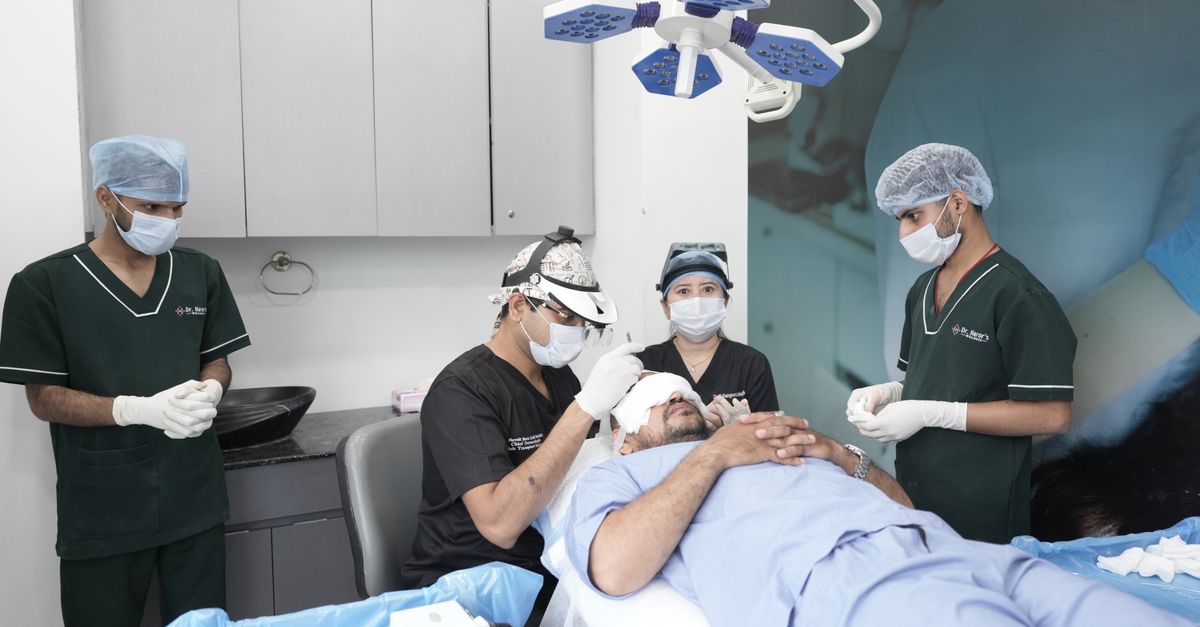
Doctours pairs you with named surgeons at 15 in-person-vetted clinics who measure donor density before quoting zone targets, including Turkey partners with Ministry of Health international health tourism authorization, and backs every booking with US-based aftercare through full growth.
Hair transplant graft density planning is how a surgeon decides how many follicular units to place in each square centimeter of your scalp — and those targets, more than raw graft count, decide whether your hairline looks natural or sparse under bright light. Most surgeons aim for about 35 to 50 grafts per square centimeter along the frontal third and a lighter 25 to 40 in the crown, well below the 80 to 100 follicular units per square centimeter of untouched scalp, because the eye reads far less than full native density as a complete head of hair. Through Doctours, vetted partner clinics measure your donor supply first, set zone-by-zone density targets second, and quote the plan as a flat-rate package from $2,200 to $7,000 — so density stays a medical decision, not a sales lever.
If you have been comparing quotes, you have probably seen the same head get very different numbers. One clinic packs the front hard. Another spreads grafts thin across everything. A third never mentions density at all — just a big graft total. So which plan actually looks right in a year — and which one burns through hair I will still need later? That quiet doubt is why a lot of guys stall with three quotes open and no clear way to pick.
Fair question. Density planning is the missing layer behind every graft number, and once you understand how surgeons set those targets, the quotes stop feeling like a coin flip. Here is what graft density really means, how targets differ by zone, why packing denser is not automatically better, and how Doctours surgeons balance follicles per square centimeter against the donor hair you will still want a decade from now.
What Does Graft Density Actually Mean?
Graft density is the number of follicular units a surgeon places in one square centimeter of recipient scalp. It is not the same as your total graft count — our graft count guide covers that demand-side math — and it is not the same as donor capacity, which caps how many grafts you can give across a lifetime. Density is the distribution plan: how tightly those grafts sit together once they land.
Native scalp usually holds about 80 to 100 follicular units per square centimeter. Transplanted hair does not need to match that. According to the International Society of Hair Restoration Surgery, natural-looking coverage commonly lands around 30 to 50 grafts per square centimeter because hair caliber, curl, and remaining native hair fill visual gaps. Put simply, you are buying the illusion of density — the look that reads full in a mirror — not a photocopy of teenage scalp.
How Do Surgeons Set Density Targets by Zone?
A careful surgeon draws different density targets for different zones, because your eye weights them differently. The hairline and frontal third get the densest packing — often 35 to 50 grafts per square centimeter — because that frame shows in every photo and every conversation. Mid-scalp usually sits in the middle. The crown, or vertex, often gets a lighter target of about 25 to 40 grafts per square centimeter, since its curved whorl shows scalp easily and can swallow grafts as surrounding loss continues. Our guide to crown versus hairline graft priorities explains why the front usually wins the first round.
Here is a planning map most experienced surgeons work from before adjusting for your hair caliber and donor reading:
Scalp Zone | Typical Target Density | Why That Target |
|---|---|---|
Hairline / frontal third | 35–50 grafts/cm² | Highest visual payoff; frames the face |
Mid-scalp | 30–45 grafts/cm² | Bridges front to back without overspend |
Crown / vertex | 25–40 grafts/cm² | Curved surface; protects lifetime reserve |
Native untouched scalp | ~80–100 FU/cm² | Reference only — not a transplant target |
Those ranges only work if your donor can fund them. Most men can safely spare about 5,000 to 8,000 grafts across a lifetime — see why donor capacity caps your lifetime grafts — so a surgeon multiplies each zone's square centimeters by its target density, then cuts the plan back to what the donor can sustain. A StatPearls review of hair transplantation treats that supply ceiling, not the bald area alone, as the real limit on what surgery can achieve.

Why Isn't Denser Always Better?
Because past a point, extra grafts stop buying visible thickness and start costing survival. Crowding too many follicles into the same square centimeter stresses blood supply, lowers take rates, and burns permanent donor hair you cannot replace. A clinic that promises "full native density" in one sitting is usually selling a number, not a decade-long plan — and our guide to safe graft limits in a single session covers why megasessions have a ceiling for a reason.
Here's the thing: density also has to age with you. Male pattern loss is progressive. Pack every available graft into a dense, low hairline at 32 and you can leave nothing for the thinning that shows up at 45. A smart hairline design pairs a natural density target with a conservative shape so the result still looks right when surrounding native hair thins. And honestly? That restraint is what separates a plan built around your future from a plan built around today's before-and-after photo.
How Does Density Planning Show Up in What You Pay?
Density targets and pricing models pull in opposite directions when a clinic charges per graft. More grafts per centimeter quietly inflate the bill. Flat-rate packages let a surgeon place only the density each zone needs. Across the Doctours network in 2026, that usually looks like this:
Pricing Model | Density Incentive | Example Through Doctours |
|---|---|---|
Flat rate per procedure | Surgeon sets medical density targets without per-graft pressure | $2,200 Standard at Esthetic Hair Turkey; $2,800–$4,160 at MetropolMED |
Graft-tier package | Ceiling keeps density planning inside a known graft budget | Dr. Hakan Clinic: $4,500 up to 3,500 grafts; $5,000 up to 5,000 grafts |
Per-graft pricing | Bill rises if density targets get padded | Motion Clinic Shaven FUE at about $3 per graft |
US clinics often charge $4 to $8 per graft for the same density math, which is why all-in packages abroad feel different even when the medical plan looks similar. The Doctours pricing page shows what a density-led plan lands at across the network, and CDC medical tourism guidance still starts with a proper clinical evaluation before any final number is locked.

How Does Doctours Plan Density Without the Upsell?
Through Doctours, density targets come from a named surgeon's reading of your donor — not from a quote that needed to win the sale. Every partner runs a real medical consultation, with photos or densitometry reviewed before zone-by-zone targets are set. Doctours is free for patients — clinics pay us for coordination — so nobody on our side profits from packing denser than your donor can support. Deposits start at $300, and payment plans run up to 36 months in USD, so the density plan stays a medical call instead of a budgeting scramble.
The vetting is what protects those targets. Before you go, Doctours has visited all 15 partner clinics in person — and Turkey partners including Heva Clinic, MetropolMED, and Vialife Clinic hold the Republic of Turkey Ministry of Health's International Health Tourism Authorization Certificate. While you are there, the surgeon confirms density against your actual donor reading, and clinics like MetropolMED (4.8 average across 29 reviews) and Dr. Hakan Clinic (4.7 across 17 reviews) are rated on natural results, not graft inflation. After you are home, your US-based care team stays on a 24/7 line through the full growth window — and our month-by-month timeline shows when each stage of density actually arrives. You can always compare the vetted network before you decide.
The Bottom Line
Density planning is the quiet decision underneath every graft number. Natural hairlines usually need about 35 to 50 grafts per square centimeter up front and less in the crown — not a chase toward full native density — and those targets only work when they leave donor hair for the years ahead.
Here's the reassuring part: once a surgeon measures your supply and maps density by zone, the plan stops feeling abstract. Through Doctours, those clinics are already vetted, packages run flat-rate from $2,200 to $7,000, and density planning is built into every match — see what your plan would cost or browse clinics when you are ready.
You have waited long enough to do this on your own terms — and doing it right means choosing density that looks natural now and still holds up when you glance in that same mirror a decade from now. That is the version worth choosing.
Want a density plan built around your donor, not a padded graft quote? A free assessment gives you surgeon-reviewed targets, flat-rate USD pricing, and a care team from intake through full growth — no pressure, no commitment.

FAQs
What is hair transplant graft density planning?
It is how a surgeon decides how many follicular units to place per square centimeter in each zone of your scalp. Doctours is the US-based facilitator that pairs you with vetted surgeons who set those targets against your donor supply first, then quote flat-rate packages from $2,200 to $7,000 across 15 partner clinics.
How many grafts per cm2 do you need for a natural hairline?
Most surgeons aim for about 35 to 50 grafts per square centimeter along the hairline and frontal third for a natural look, which is well below the 80 to 100 follicular units per square centimeter of untouched scalp. The eye reads that range as full coverage without burning through your lifetime donor supply.
Why isn't transplant density as high as natural hair?
Native scalp holds roughly 80 to 100 follicular units per square centimeter, but transplanted hair only needs about 30 to 50 grafts per square centimeter to look dense because of how light, hair caliber, and surrounding native hair fill the gaps. Packing toward full native density usually lowers graft survival and empties a finite donor reserve of about 5,000 to 8,000 lifetime grafts.
Do hairline and crown use the same graft density?
No. Surgeons usually pack the hairline denser than the crown because the front frames your face in every photo and conversation. The crown often gets a lighter density — roughly 25 to 40 grafts per square centimeter — because it sits on a curved surface and can consume grafts faster as surrounding loss continues.
How does Doctours handle graft density planning?
Doctours matches you with named surgeons at 15 in-person-vetted clinics who measure your donor density before locking zone-by-zone targets, then quote the plan as a flat-rate package rather than a per-graft upsell. Deposits start at $300, payment plans run up to 36 months in USD, and a US-based care team stays with you through the full growth window.